


Safe occasional lease
for landlords
We eliminate the biggest obstacle to signing this agreement — we provide a legal fallback address for the tenant with the property owner's notarially certified consent. Documents ready in 24 hours, accepted by every notary in Poland.
What do landlords worry about?
Choose your scenario and see how an occasional lease — and we — solve the problem.
Tenant refuses to leave — and you wait for years
With a standard lease, eviction means a lawsuit, months of proceedings and mandatory waiting for social housing provided by the municipality. The tenant stays, you bear the costs — and you cannot do anything faster than the court allows.
Solution — An occasional lease works differently. Before the tenant moves into your apartment, they sign before a notary a statement of voluntary submission to enforcement and indicate an address they will move to. When the agreement expires or is terminated, you apply for an enforcement clause — without a full court process, without waiting for social housing from the municipality.
- Eviction without the need for municipal social housing
- Procedure simpler and faster than with a standard lease
- The tenant commits to vacating before the agreement is even signed
Rent arrears mount — and debt recovery is another problem
With a standard lease, when a tenant stops paying, the owner must initiate separate court proceedings for payment. All the while the tenant lives in your apartment, the debt grows, and the recovery and legal costs are yours alone.
Solution — In the occasional lease package with Art. 777 of the Civil Procedure Code, the tenant signs before a notary a statement of voluntary submission to enforcement regarding financial obligations. If the tenant stops paying rent or seriously violates the lease terms — you have grounds to terminate and refer the matter directly to a bailiff. No separate lawsuit, no more months waiting for a judgment.
- Enforcement of rent arrears without a separate court process
- Grounds for eviction of a tenant who violates the agreement terms
- Enforcement title is created on the day the occasional lease is signed
A standard lease protects the tenant — not you
The Tenant Rights Protection Act works primarily in the tenant's favour. Terminating the agreement, eviction, rent increase — each of these steps is restricted by rules that protect the tenant even when they do not pay and do not honour the agreement.
Solution — An occasional lease is the only form of tenancy provided for in that same act which genuinely balances the rights of both parties. A fixed-term agreement, a notarial statement and an indicated fallback address are mechanisms that work in your favour from day one — before any problem arises.
- Fixed-term agreement — expires automatically without additional formalities
- Eviction without the need for municipal social housing
- Clear, predictable rules for terminating an occasional lease
You want an occasional lease but the tenant has no fallback address
To conclude an occasional lease the tenant must indicate a property they will move to in the event of eviction and provide written consent from its owner. Family abroad, no close contacts in Poland, friends with no time for a notary — this is the most common obstacle that blocks the signing at the last minute.
Solution — This is where we come in. We provide a legal fallback address for an occasional lease together with the owner's statement — with a notarially certified signature or in electronic form. Your tenant receives the complete document within 24 hours and goes to the notary with all the paperwork in order.
- Complete documentation: KW number, property address, owner details
- Ready within 24h — the signing deadline stays on track
- Accepted by notaries throughout Poland



How to order an address for an occasional lease for your tenant?
You list the apartment and find a tenant
You advertise the apartment, talk to candidates and choose a tenant. When the question of an occasional lease comes up — you do not need to worry about how to solve the fallback address issue. That is what we are here for.

You order the documents for your tenant online
You choose a package and fill in a short form with the tenant's details — without leaving home. After verification we prepare the property owner's statement. The tenant receives the scan by email within 24h, and we send the original via InPost.

The tenant signs the agreement at the notary — you hand over the keys
With the complete document package the tenant goes to any notary in Poland. They sign the statement, you both sign the occasional lease — and the apartment officially passes into their hands. Remember: report the lease to the tax office within 14 days of the start of the tenancy.

OUR CLIENTS' REVIEWS
Everything went smoothly and professionally. I recommend it to every landlord.
The address was delivered quickly and the notary accepted it without questions. Great service.
Very helpful service. They helped me choose the right package for my situation.
Fast completion, the documents arrived by mail the same day.
Professional at every step. Recommended for anyone looking for a fallback address.
Quick, affordable and without unnecessary formalities. Everything arrived by mail the next day.
Everything went smoothly and professionally. I recommend it to every landlord.
The address was delivered quickly and the notary accepted it without questions. Great service.
Very helpful service. They helped me choose the right package for my situation.
Fast completion, the documents arrived by mail the same day.
Professional at every step. Recommended for anyone looking for a fallback address.
Quick, affordable and without unnecessary formalities. Everything arrived by mail the next day.
Is this legal?
Yes — completely. An occasional lease and the fallback address service are explicitly regulated in the Act of 21 June 2001 on the protection of tenants' rights, municipal housing stock and amendment of the Civil Code (Art. 19a–19e). This is not a workaround — it is a tool that the act specifically provides so that the owner has real protection.
If the tenant does not vacate after the agreement expires or stops paying rent — you hold a notarial deed drawn up under Art. 777 of the Civil Procedure Code. This is an enforcement title which, once an enforcement clause is granted by the court, allows you to refer the matter directly to a bailiff. No separate court proceedings, no waiting for social housing from the municipality.
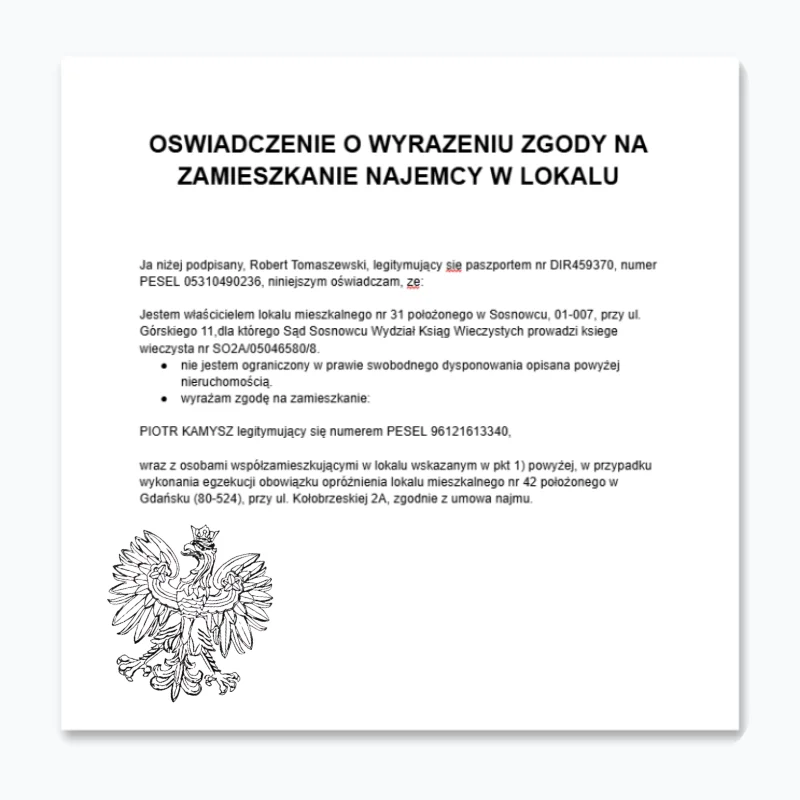
As the owner of the property we have the right to consent to another person living in our premises. This consent — certified notarially or electronically — is the document that the act requires and that notaries throughout Poland accept without reservation.
How to verify the legality of the document?
- Check the land register number at ekw.ms.gov.pl — you can confirm the property exists and the owner details match.
- Notarial certification of the signature guarantees that the signature was made by the person named in the document — the notary verifies identity before certifying.
- An electronic document with a qualified electronic signature has the same legal force as a written form — it is verifiable online.
Every document we issue contains the KW number, property address and owner details — you can verify them yourself before signing the occasional lease.
Legal basis
Art. 19a–19e of the Act
on the protection of tenants' rights
on the protection of tenants' rights
What should a landlord remember?
An occasional lease provides real protection — but only when all formalities are completed correctly and on time.
01
The agreement must be in written form
An occasional lease agreement requires written form — a verbal agreement has no legal effect and provides no protection. Make sure the document contains all required elements: parties to the agreement, property address, rent amount, tenancy period and termination conditions.
02
Fixed-term agreement only (max. 10 years)
An occasional lease can only be concluded for a fixed term — up to a maximum of 10 years. When this period expires the agreement ends automatically without any notice being required. If you want to continue the tenancy, you sign a new agreement.
03
Report to the tax office within 14 days
As the landlord you are required to report the agreement to the competent tax office within 14 days from the start of the tenancy, not from the date of signing. You can submit the report on paper or electronically as a general letter — keep proof of submission (UPP or reception stamp).
04
The tenant must be a natural person
An occasional lease applies only to residential premises rented to natural persons for residential purposes. It cannot be used when the tenant runs a business from the premises or when the property is to serve as an office or company registered address.
05
The landlord cannot be a property development company
An occasional lease can only be used by landlords who are natural persons. The rules do not apply to entities running commercial rental activities — if you rent privately as a natural person, this condition is automatically met.
06
Complete document set before the notary visit
Before the tenant goes to the notary, make sure they have all the required documents: the fallback address indication, the statement of the indicated property owner and the signed occasional lease agreement. If any one of these is missing the notary will not draw up the deed — and the signing date is lost.
THEY WORK WITH US
OTODOM
OLX
R&L ESTATE
WSPARCIE NAJMU
MORIZON
GRATKA
OTODOM
OLX
R&L ESTATE
WSPARCIE NAJMU
MORIZON
GRATKA
Need help?
Leave your number and we will call you back with a free consultation.
FREQUENTLY ASKED QUESTIONS
An occasional lease is reported to the tax office competent for the landlord's place of residence — not for the address of the rented property. If you live in Krakow and rent out an apartment in Warsaw, you submit the report to your Krakow tax office.
In practice, you do not need to travel to the tax office in the city where the apartment is. You can submit the report electronically as a general letter via the e-Tax Office portal — without leaving home.
Only the landlord submits the report — the tenant has no such obligation. The steps are as follows:
- Step 1. Sign the occasional lease and gather all documents.
- Step 2. Prepare a letter with the landlord's details, address of the rented property, agreement date and tenancy start date.
- Step 3. Submit the letter on paper at the tax office or electronically via the e-Tax Office portal as a general letter.
- Step 4. Keep proof of submission — UPP for online submission or a reception stamp for the paper version.
In practice the whole procedure takes around fifteen minutes and does not require a visit to the tax office.
14 days from the start of the tenancy — not from the date of signing the agreement. This is the most common mistake landlords make. If you sign the agreement on 1 March and the tenant moves in on 15 March, the deadline is counted from 15 March.
In practice it is worth planning the report in advance — ideally right after the tenant moves in, so you do not forget in the bustle of handing over the apartment. Failing to report the lease on time deprives you of some of the rights that come with an occasional lease.
Yes — our property is a real piece of real estate with an up-to-date land register. The indicated address exists, the owner has consented to the tenant moving in, and the document contains all the details required by law: KW number, property address and owner details.
You can verify this yourself before signing the agreement — check the land register number free of charge at ekw.ms.gov.pl. Notaries throughout Poland accept our documents without reservation, because they meet all the formal requirements under Art. 19a–19e of the Tenant Rights Protection Act.
In practice, as the landlord you can be sure that the fallback address indicated by the tenant is real and enforceable — which is crucial if you ever need to use the eviction procedure.
The process involves several steps. First, agree the tenancy terms and prepare the agreement in written form for a fixed term — up to a maximum of 10 years. Then gather the required documents:
- the tenant's fallback address indication,
- the statement of the indicated property owner with a notarially certified signature,
- the tenant's statement of voluntary submission to enforcement (Art. 777) — signed at a notary.
When the complete set is ready, the tenant goes to the notary, signs the statement, and you both sign the agreement. Finally, as the landlord you report the lease to the tax office within 14 days of the start of the tenancy.
In practice, the biggest obstacle is gathering the documents on the tenant's side — especially the fallback address indication. If you want to be sure this stage does not block the whole process, we can prepare those documents within 24 hours.